
Sacred Grounds & Living History
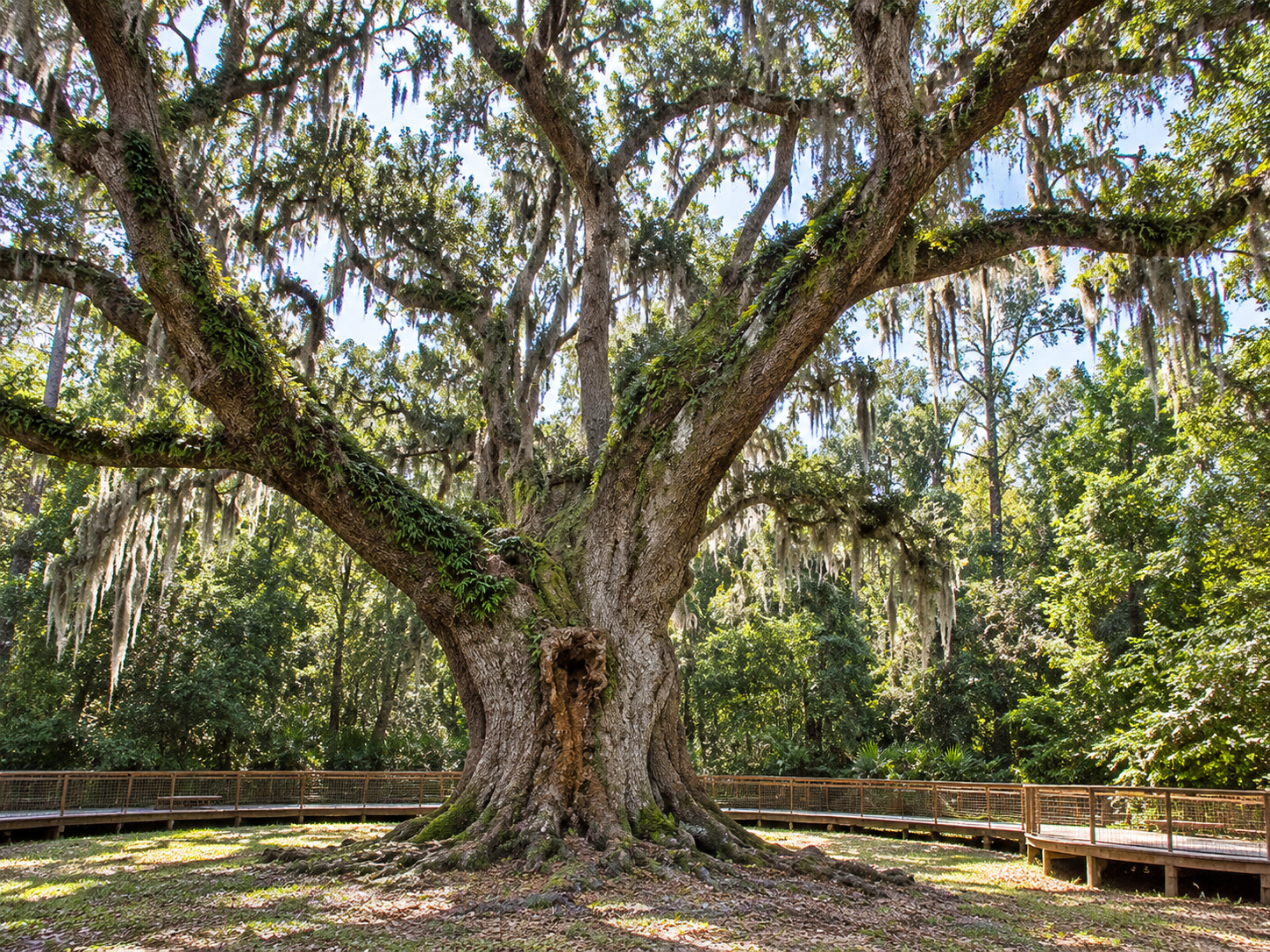
Jackson's Oak
The ancient live oak that sheltered Andrew Jackson's army, witnessed the birth of a nation's southern frontier, and still stands on the original D'Olive land grant in Daphne, Alabama.
The Tree That Witnessed History
On the original 1,200-acre Spanish Land Grant awarded to Dominique D'Olive in 1787, there stands an ancient live oak of extraordinary size and age — known today as Jackson's Oak. This magnificent tree, estimated to be several centuries old, became forever linked to American history when General Andrew Jackson camped beneath its sprawling canopy during the War of 1812.
In January 1815, General Jackson marched his forces through the eastern shore of Mobile Bay en route to the Battle of New Orleans — the engagement that would make him a national hero and eventually carry him to the presidency. His troops made camp on the D'Olive land, and Jackson himself is said to have rested beneath this great oak, using it as a command post and shelter during the campaign.
The tree's survival across more than two centuries is itself a testament to the D'Olive family's stewardship of their land. While the surrounding landscape was transformed by development, roads, and the growth of Daphne, the oak endured — a living bridge between the colonial era of Dominique D'Olive and the present day.
Jackson's Oak stands not merely as a botanical curiosity but as a sacred landmark — the point where the D'Olive family's story intersects with the founding narrative of the American South. It is the oldest living witness to everything that transpired on this land: the Spanish grant, the Creek War, the Civil War, and the quiet generations of a family that refused to be forgotten.
Location
Original D'Olive Land Grant, Daphne, Alabama
Historical Event
Gen. Andrew Jackson camped here, January 1815
Significance
Named landmark on the original 1787 Spanish Land Grant
Status
Standing — a living monument to D'Olive and American history
The D'Olive Cemetery
Nestled on the original 1,200-acre Spanish Land Grant along the eastern shore of Mobile Bay, the D'Olive Cemetery is more than a burial ground — it is the physical anchor of a family's centuries-long presence in Baldwin County, Alabama.
Established in the late 18th century, the cemetery holds the remains of Dominique D'Olive's descendants, marked by headstones bearing French inscriptions — a testament to the family's enduring connection to their Gascon roots even as they built new lives in the American South.
Oldest Family Cemetery in Daphne
The D'Olive Cemetery predates the formal incorporation of Daphne, Alabama, making it one of the oldest continuously recognized family burial grounds on the eastern shore of Mobile Bay.
French-Inscribed Headstones
Several headstones bear inscriptions in French — a rare and moving reminder that the D'Olive family never fully severed their cultural ties to Tillac, Gers, France, even generations after Dominique's crossing.
The Stolen Wrought Iron Gate
The original ornate wrought iron gate that once enclosed the cemetery was vandalized and stolen during the Union troop occupation of 1865. Its loss remains one of the most painful chapters in the family's stewardship of this sacred ground.
On the Original Land Grant
The cemetery sits within the boundaries of the 1787 Spanish Land Grant awarded to Dominique D'Olive — the same land that once held La Belle Rose Hotel, the sawmill, the brickyard, and Jackson's Oak.
Louis D'Olive — Memorial Inscription
"Here lies Louis D'Olive, son of Dominique, steward of the land granted by the Spanish Crown in 1787. He built upon this shore a home, a legacy, and a name that endures. May his memory be as enduring as the oaks that shade this ground."
— Memorial inscription, D'Olive Cemetery, Daphne, Alabama
History of the Sacred Grounds
Land Grant Established
Dominique D'Olive receives 1,200 acres from the Spanish Crown. The land that will become the family cemetery is part of this original grant along the eastern shore of Mobile Bay.
First Burials
Following Dominique D'Olive's death in 1803, the family establishes a formal burial ground on the estate. French-inscribed headstones mark the earliest graves.
Creek War Survives
The Creek War attack on the D'Olive estate in 1813 damages the surrounding property but the cemetery grounds are preserved. Louis D'Olive rebuilds the estate in the aftermath.
Union Occupation & Gate Theft
Union troops occupy the D'Olive estate during the final months of the Civil War. The ornate wrought iron gate enclosing the cemetery is vandalized and stolen — a wound the family never fully healed.
Cemetery Recognized
As Daphne grows around the original land grant, the D'Olive Cemetery is formally recognized as the oldest family burial ground in the area. Local historians begin documenting the French-inscribed headstones.
A Living Memorial
The D'Olive Cemetery continues to be recognized as a historic landmark in Baldwin County. Descendants and researchers visit to pay respects and document the inscriptions that connect this Alabama soil to 18th-century France.
Preserving Sacred Ground
The D'Olive family is committed to the preservation and documentation of this historic cemetery. If you are a researcher, historian, or descendant with records, photographs, or knowledge of the cemetery, we welcome your contribution to this living archive.
Contact the Family