

Etymology · Orthography · Identity
The D'Olive Name
From a village in Languedoc to the Eastern Shore of Mobile Bay — how a French surname crossed an ocean, passed through Spanish colonial records, and became the name that marks a creek, a bay, a road, and a family.
A Name with Deep Roots
The surname D'Olive — in its many spellings — is one of the oldest documented family names associated with the Eastern Shore of Mobile Bay. It appears in Spanish land grant records, American census rolls, church baptismal registers, and on the landscape itself: D'Olive Creek, D'Olive Bay, D'Olive Branch, D'Olive Road. Few family names in Baldwin County have left so visible a mark on the geography of the region.
But the name did not arrive in Alabama fully formed. It traveled — through France, across the Atlantic, through the Spanish colonial administration of Louisiana and the Mobile District, and into the American republic. At each stage, the spelling shifted, the pronunciation adapted, and the name took on new forms while retaining its essential identity.
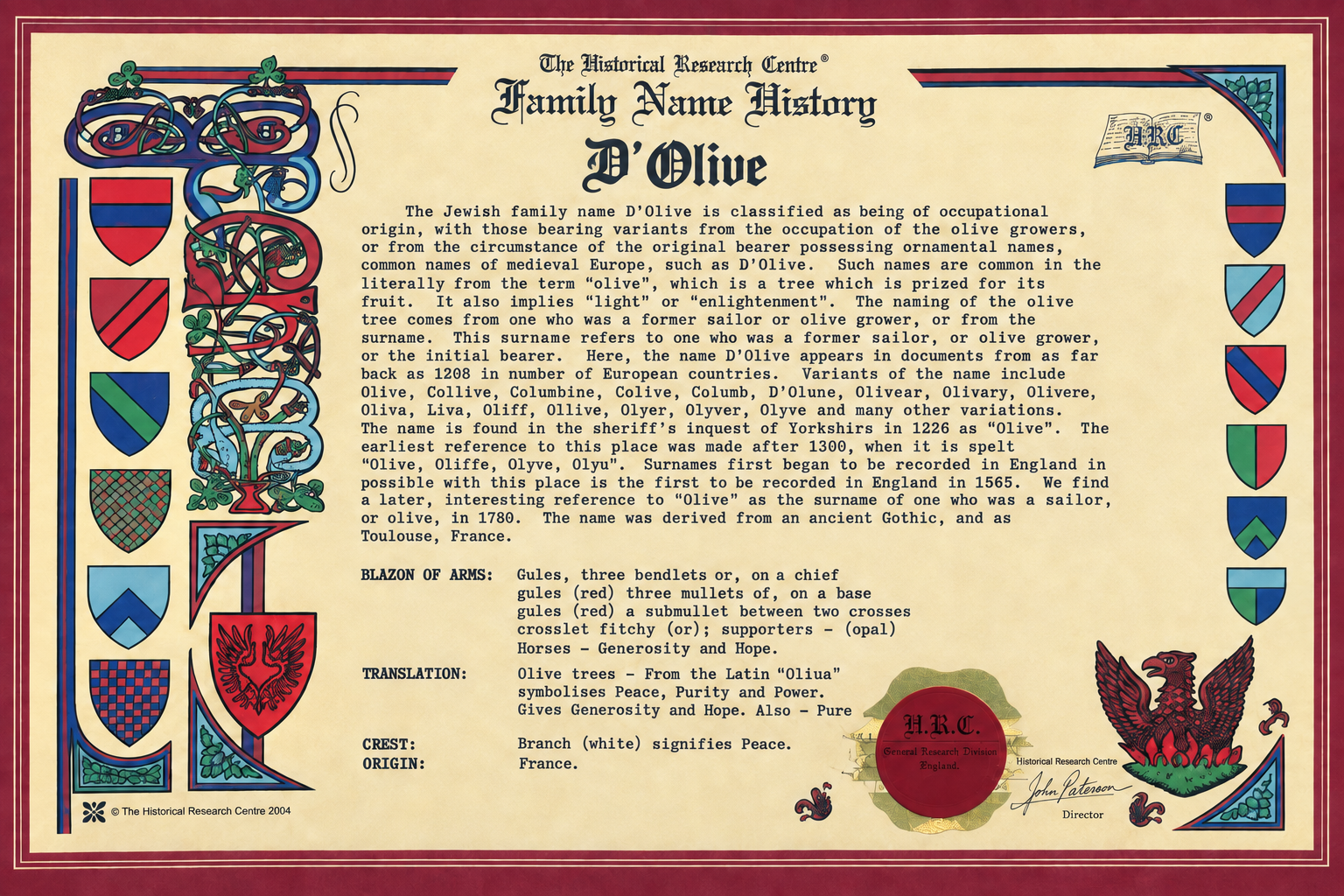
The D'Olive Family Name History — a research document tracing the surname's etymology, variant spellings, and geographic presence, preserved in the family archive.
French Origins: Olive, Oliva, Olivier
The root of the D'Olive name is the French word for olive — olive — and the Latin oliva. In medieval and early modern France, surnames derived from trees, plants, and landscape features were common, particularly in the south, where the olive tree was a familiar and valued part of the agricultural landscape. The Languedoc region, where the D'Olive family's heraldic arms were confirmed in 1669 and 1670, was olive-growing country.
The family appears in French records under several related forms: Olive, Oliva, and Olivier. These were not different families but different orthographic conventions applied to the same name — a common feature of pre-standardization French record-keeping, where a clerk might write a name as he heard it, or as local dialect rendered it. The sovereign heraldic judgments of 1669 and 1670 refer to the family of Olive or Olivier, treating the two forms as interchangeable.
The particle 'd'' — meaning 'of' or 'from' — was added as a marker of place or origin, a common French naming convention. D'Olive thus means, literally, 'of Olive' or 'from the olive place' — a name rooted in landscape and locality, as so many French surnames are.
D'Olive in France — Nobility, Land, and Legacy
Nobility and Origin
The "d'" prefix in French surnames means "of" or "from," typically indicating nobility, land ownership, or geographic association. Olive can refer to the olive tree, a place named Olive, or — more rarely — a reference to peace, as the olive branch is a universal symbol. Historic French families bearing the name d'Olive included minor nobility, magistrates, and landowners, particularly in southern France where olive cultivation was central to daily life.
Geographical Roots
The surname d'Olive appears in records from Provence, Languedoc, and Aquitaine — regions long known for olive cultivation and noble landholding. It surfaces in old baptismal, marriage, and property records throughout these provinces. Hamlets and place names containing Olive — such as Saint-Martin-d'Olive and La Bastide d'Olive — may themselves be the geographic origin of the surname for certain branches of the family.
Historical Records
Notable mentions of the d'Olive family appear in archives related to local governance, land disputes, and church documents dating back to the 16th through 18th centuries. The surname was sometimes rendered as Dolive — without the apostrophe — in older documents, especially when transcribed into English by colonial-era clerks unfamiliar with French orthographic conventions.
Migration to America
Some d'Olive families migrated from France to other parts of the world, including the U.S. Gulf Coast — notably Mobile, Alabama, where the D'Olive name is well established in local history. Dominique D'Olive arrived in the late 18th century and received a Spanish land grant on the Eastern Shore of Mobile Bay, planting the name permanently in American soil.
Primary Source: The 1775 Letters of Joseph-Denis d'Olive
Two letters written from Paris in May 1775 by Joseph-Denis d'Olive — President of the Chamber of Petitions, Parlement of Toulouse — to his brother Bernard-Denis survive in the Archives Départementales de Haute-Garonne (ADHG – 1J720). They document the family's land holdings, estate management, children's education, and noble network in extraordinary detail, just years before Dominique D'Olive departed for the New World.
Read the full account on the Family in France page →Heraldry
Families bearing the d'Olive name may carry their own coat of arms (blazon), typically featuring olive branches or trees as symbols of peace, prosperity, and nobility. The heraldic tradition of the d'Olive family was confirmed in Languedoc during the great armorial survey of 1669–1670, cementing the family's noble standing in the records of the French crown.
Six Forms of One Name
Olive
Medieval French
The base form of the surname, found in Languedoc records and the sovereign heraldic judgments of 1669–1670. Used interchangeably with Olivier in early documents.
Oliva
Latin / Ecclesiastical
The Latinate form, used in ecclesiastical and formal legal records. Dominique's baptismal record (Archive E696, Tillac, 1741) uses this form.
Olivier
French variant
The most common French surname derived from the olive tree. The heraldic judgments treat Olive and Olivier as the same family name.
d'Olive
French noble particle
The form with the noble particle 'd'' indicating origin or place. Used by Dominique in his own signature and in Spanish colonial records.
D'Olive
American / anglicized
The capitalized American form, standardized in U.S. census records, land deeds, and family usage from the early nineteenth century onward.
Dolive
Anglicized variant
A simplified anglicization dropping the apostrophe, found in some American census records and informal usage. The family has consistently preferred the apostrophe form.
Through Spanish Colonial Records
When Dominique D'Olive arrived in the Mobile Bay area around 1770–1771, he entered a Spanish colonial world. The Mobile District was under Spanish administration from 1780, and the land grant Dominique received in 1787 was issued by the Spanish Crown through Governor Esteban Miró. Spanish colonial clerks, working in a language with no direct equivalent for the French particle 'd'', rendered the name in various ways — sometimes as 'de Olive,' sometimes as 'd'Olive,' sometimes simply as 'Olive.'
The 1787 land grant document itself is a key primary source for the name's colonial-era spelling. It records the grantee as Dominique D'Olive — preserving the French form even within a Spanish administrative document. This suggests that Dominique himself insisted on the French spelling of his name, or that the colonial clerk was sufficiently familiar with French naming conventions to render it correctly.
Into the American Republic
When the United States took possession of Mobile in 1813 and Baldwin County was organized, the D'Olive family's name entered American record-keeping systems. U.S. census takers, land deed clerks, and court recorders — most of them English-speaking — encountered the French apostrophe form and handled it with varying degrees of fidelity.
The family itself maintained the D'Olive spelling through the nineteenth and twentieth centuries, and it is this form — with the capital D, the apostrophe, and the capital O — that appears on the landscape today: D'Olive Creek, D'Olive Bay, D'Olive Branch Road, D'Olive Park. The name has been formally recognized in Baldwin County's geographic nomenclature, a rare distinction that speaks to the family's deep roots in the region.
The Name on the Land
Five places in Baldwin County still carry the D'Olive name — a living record of the family's two-century presence on the Eastern Shore.
D'Olive Creek
A tributary of D'Olive Bay, flowing through what was once the original land grant property. The creek bears the family name on modern maps and in official Baldwin County records.
D'Olive Bay
An inlet of Mobile Bay on the Eastern Shore, named for the D'Olive family whose land bordered its shores. One of the most visible geographic markers of the family's presence.
D'Olive Branch
A smaller waterway feeding into D'Olive Creek, extending the family's name deeper into the watershed of the Eastern Shore.
D'Olive Road
A road in Baldwin County bearing the family name, running through the area of the original land grant.
D'Olive Park
A public park in the D'Olive Creek watershed, named for the family whose land once encompassed the surrounding area.
"The creek still runs. The bay still bears the name. The road still carries it. Five places in Baldwin County are the family's most durable monument — not stone, but geography."
D'Olive Family Heritage Archive
From Olive to D'Olive
Olive / Olivier in Languedoc
The family name appears in Languedoc records in its base forms — Olive and Olivier — rooted in the olive tree and the landscape of southern France.
Sovereign Heraldic Confirmation
The sovereign judgments of September 23, 1669 and January 10, 1670 confirm the arms of the family of Olive or Olivier — treating both forms as the same family name.
Baptismal Record: 'd'Olive'
Dominique's baptismal record in Tillac, Gers (Archive E696) records the name in its Latinate and French forms, establishing the documentary baseline for the American branch.
Spanish Land Grant: 'D'Olive'
The Spanish colonial land grant preserves the French form 'D'Olive' in an official document — evidence that Dominique maintained his French spelling in the colonial record.
American Record-Keeping
U.S. census and land deed records begin to document the family under various spellings. The family consistently uses D'Olive with the apostrophe.
Five Named Places
D'Olive Creek, D'Olive Bay, D'Olive Branch, D'Olive Road, and D'Olive Park preserve the family name on the landscape of Baldwin County — a living monument to the family's two-century presence on the Eastern Shore.